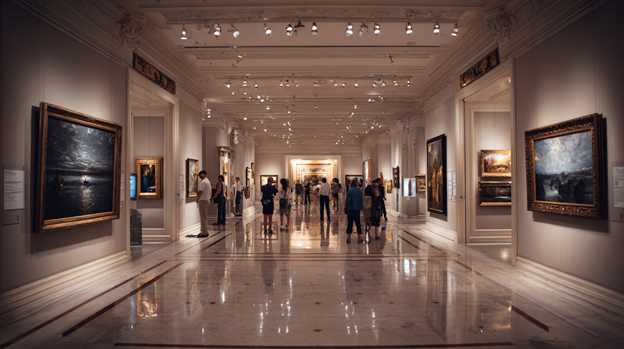
Despite the innumerable amount of artwork in daily production, the global art world revolves around a small group of institutions. In 2026, four galleries out of this little group stood out of the pack: the Paris’ Louvre, New York’s Museum of Modern Art, London’s Tate Modern, and Florence’s Uffizi Gallery. Let’s see these four art galleries and how they continue to influence the lives and activities of everyday artists.
The Louvre
The Louvre in Paris remains the most visited art museum in the world. Last year, it recorded about 9.04 million visitors who came to explore its multivaried exhibitions. Its influence comes from its global recognition and collection depth, which includes legendary works like Mona Lisa.
As you might expect, however, the museum faces pressure from overcrowding as visitor levels have superseded the initial capacity designed for key areas. This has forced the center to hold world-class structural upgrades and crowd management systems you can hardly find in other art galleries. However, regardless of its challenges, the Louvre sets a global benchmark for art houses.
The Museum of Modern Art
The Museum of Modern Art in New York, commonly known as MoMA, attracted nearly 6 million visitors in 2025. Unlike other main galleries that rely on ancient collectibles, MoMA relies on modern movements, digital art, photography, and experimental media.
About 44% of global art sales is linked to modern creatives. Thanks to its existing product depth, massive collection, and rising demand in the US market, MoMA plays a strong role in driving modern art sales today. If anything, MoMA is one of the leading platforms that clearly link market behavior with institutional art.
Tate Modern
Tate Modern is one of the most influential modern art spaces in Europe. In 2025, it Tate Modern recorded around 4.5 million visitors, putting it among the top ten most visited museums globally. This notable art gallery concentrates on large-scale installations, conceptual art, and international exhibitions that help to drive its mission. It also boasts an industrial architecture that redefines it as a modern cultural space.
However, visitor trends in the UK have been volatile recently with some art institutions recording declining attendance since the pandemic. Researchers have linked the fluctuations to prevailing tourism and economic conditions. Despite this, there’s no denying the regional and global influence of Tate Modern in driving contemporary art conversations.
The Uffizi Gallery
The Uffizi Gallery in Florence represents the classical foundation of Western art history. Unlike MoMA or Tate Modern, its influence is tied to its array of Renaissance collections. Works from leading artists like Botticelli, Michelangelo, and Leonardo da Vinci mark this center as an anchor for classical art.
Unsurprisingly, visitor numbers are lower than the Louvre or MoMA here. However, they’re still globally significant. The gallery consistently ranks among the top visited art museums worldwide, contributing to Italy’s strong museum tourism sector.
That’s not all. Global museum data shows that major European institutions like Uffizi continue to attract millions of visitors annually, with several exceeding 3 to 4 million yearly attendance levels. For Uffizi, dominance isn’t just about scale, it’s about historical authority, one that preserves foundational works and defines Western art education and museum engagements.
Conclusion
Even today, the global art world is centered around a small group of institutions with outsized influence. These institutions include four main platforms that gallantly combine scale, authority, and cultural relevance in their user experience.
They dominate in different ways, but converge at a central theme. All have massive visitor numbers to show their reach, just as market data unhypocritically demonstrate their reach. Louvre leads in scale and historical breadth while MoMA is excellent with redefining modern artistic direction. Tate Modern is excellent for shaping contemporary European culture while Uffizi can’t stop being a cultural heritage, at least for now.